Posted by Electro-Steam on | Comments Off on Yes, You Can Steam Clean Electrical Panels! The Myth of Moisture
Mention spraying steam near an active electrical panel, and most plant managers will look at you like you’ve completely lost your mind.
It makes sense. We’ve all been taught the golden rule of industrial safety: water and electricity do not mix. The assumption is simple, steam plus electricity equals an immediate short circuit, blown fuses, or ruined components. Except, in the world of dry steam cleaning, that assumption is mostly wrong.
The “Myth of Moisture” How Dry Steam Actually Works
The fear of cleaning around electronics with steam comes from a misunderstanding of what steam actually is in an industrial context. Traditional pressure washers or wet-steam systems drench surfaces in liquid water. Dry vapor steam, on the other hand, is an entirely different beast.
Dry vapor steam systems operate under high pressure and high heat, producing vapor that is 95% to 98% dry. It contains only a tiny fraction of liquid water compared to standard cleaning methods.
Here is why that matters for sensitive equipment:
Instant Evaporation: The intense heat instantly breaks down grease, oil, and grime on contact. The steam vapor evaporates almost immediately leaving minimal surface moisture that dries quickly
No Standing Water: Because there is no liquid runoff, water can’t pool inside sensitive enclosures or collect in conduit lines.
Zero Chemical Residue: Dry vapor eliminates the need for conductive and corrosive chemical cleaners or water rinses.
When applied correctly, dry steam lifts stubborn buildup off control panels without causing electrical shorts or corrosion.
Five Places You Forgot to Clean (That Dry Steam Tackles Easily)
Sanitation isn’t just about wiping down the main conveyor belt. Dust, grease, and moisture build up in the overlooked corners of your facility, creating harborages for bacteria or causing equipment failure over time.
Here are five places you might be skipping and how dry vapor steam cleans them safely:
1. Control Panels & Electrical Housings
Dirt and airborne oils collect on human-machine interfaces (HMIs), wiring harnesses, and switchgear. Dry vapor steam melts away grime and sanitizes touchpoints without infiltrating sensitive electrical connections.
2. Condenser Fins & Refrigeration Coils
Pressure washers can easily bend delicate aluminum condenser fins, and chemical cleaners leave behind unwanted odors in food-processing environments. Dry steam penetrates deep into coil banks, melting away buildup without damaging the structure or flooding cold storage areas.
3. Diamond Decking & Textured Flooring
Non-slip diamond plating is great for worker safety, but the deep grooves are notorious for trapping grease, food particles, and dirt. Dry steam blasts deep into the diamond pattern, lifting embedded dirt that standard mops and scrubbers leave behind.
4. Conveyor Motors & Proximity Sensors
Traditional hose-downs require tediously bagging or taping off motors, encoders, and sensors before washing. Dry vapor allows you to clean around these sensitive components directly, drastically cutting down on prep and downtime.
5. Gaskets, Seals, and Door Tracks
Microscopic cracks in rubber gaskets and tight tracks around cold-storage doors are breeding grounds for mold and bacteria. The heat of dry steam sanitizes these tight spots effortlessly where brushes can’t reach.
Unlock True Facility Versatility
Rethinking your sanitation routine doesn’t mean risking your equipment. By leveraging high-temperature dry vapor, you can clean harder, reach tighter spaces, and protect sensitive electronics, all with a single piece of equipment.
Ready to Streamline Your Cleaning Protocol?
Stop spending hours bagging electronics or scrubbing stubborn decking by hand. Learn how dry vapor steam generators can transform your facility’s maintenance routine at Electro-Steam. Contact us today to speak with a dry steam specialist!
Posted by Electro-Steam on | Comments Off on Why Water Wash-Downs Are Ruining Your Dry Food Production, and the Fix!
If you manage a commercial bakery, a snack food plant, or a facility that processes powdered ingredients, you live by a different set of rules than the rest of the food industry.
In a meat processing plant or a dairy facility, water is often the primary cleaning tool. But in your world—where flour, sugar, seasonings, and dry mixes rule—water is the enemy.
The least bit of moisture can ruin an entire production run. It causes dry powders to clump, seasonings to spoil, and crispy snacks to lose their texture. Worse, introducing water into a dry environment creates an immediate breeding ground for mold and bacteria in cracks and crevices—the very things you are trying to eliminate.
So, how do you meet strict industry regulations for sanitation without destroying your product or your equipment?
The Problem with “Traditional” Methods
For years, dry food processors have been stuck between a rock and a hard place.
Wet Washing creates mess, waste, and long drying times that kill your production schedule.
Compressed Air, while dry, is often dangerous. It doesn’t actually sanitize; it simply blows particles around. This increases the risk of allergen cross-contamination, blowing mold spores or peanut dust from one conveyor belt onto another, or into the facility’s air system.
The Solution: Dry Steam Sanitation
The answer lies in physics: High-temperature, low-moisture steam.
Dry steam technology, like the systems manufactured by Electro-Steam, is the “go-to” solution for water-sensitive environments. Here is why it is the superior choice for bakeries, snack manufacturers, and packaging operations:
It Evaporates Immediately
“Dry” steam isn’t a misnomer. Electro-Steam generators produce vapor with very low moisture content. Because the temperature is so high, the steam cleans and disinfects surfaces and then evaporates almost instantly. You can sanitize a conveyor belt or a mixer and have it back in production minutes later, not hours later.
It Tackles Sticky Residue Without Soaking
Bakery conveyor belts are notorious for sticky residue—fruit fillings, sugary glazes, and binding ingredients. Scraping them is labor-intensive, and washing them soaks the belt. Dry steam cuts through tough grease and sugar using heat, releasing the residue so it can be easily wiped or vacuumed away, all without soaking the machinery.
It is Safe for Electrical Parts
In dry processing plants, packaging equipment is often full of sensitive sensors, control panels, and electrical components. You can’t hose these down. However, dry vapor is safe for use on electrical control panels, ensuring you can sanitize the entire line—not just the mechanical parts.
It Actually Sanitizes (Unlike Air)
Unlike compressed air which just moves dirt around, heat kills. Dry steam penetrates cracks, crevices, and pours to kill pathogenic bacteria, mold spores, and even insect eggs on contact. It provides a true kill step that manual wiping simply cannot achieve.
Keep Your Powder Dry (And Clean)
You shouldn’t have to choose between sanitation and product quality. Whether you are dealing with diamond deck flooring, mesh conveyor belts, or delicate blending tanks, dry steam offers the power of a wash-down without the water. Electro-Seam offers an extensive selection of dry steam equipment for most any application.
Ready to see how it works in your facility?
Every production line is unique. At Electro-Steam Generator Corp, we have decades of experience helping clients design customized solutions for their specific applications.
Contact us today to speak with a dry steam expert about your needs or to arrange a free demonstration at your facility. Let us help you save on labor costs and reduce downtime while keeping your dry environment truly dry.
Posted by Electro-Steam on | Comments Off on Understanding Dry Steam: Moisture Content, Pressure & Temperature Explained
Dry steam exists almost entirely in a vapor state and contains very little suspended water droplets. In other words, it is essentially water in its purest, gaseous form. Dry steam can be safely used for cleaning areas that cannot be exposed to water, delicate areas and spaces or equipment that can’t be exposed to water. Dry steam effectively kills harmful allergens and bacteria, leaving surfaces dry and ready for use.
In this guide, learn more about dry steam and how it enables efficient, safe cleaning in various industrial applications.
Moisture Content
Distinguishing dry steam, saturated steam, and other types of steam used in industrial cleaning involves understanding moisture content. Heating steam to the boiling point will produce saturated steam.
Saturated steam is not fully dry, and typically contains a moisture content between 3% and 5%. Dry steam is considered steam with less than 5% moisture and superheated steam is heated beyond the boiling point, which removes any remaining moisture before the steam reaches its point of use. This is why dry steam and superheated steam are ideal for various industrial applications that involve cleaning, sanitation, fast drying, or controlled curing.
Operating Pressure
Steam has a direct correlation between temperature and operating pressure. As the pressure of the steam grows, so does its corresponding boiling point temperature. For example, at standard atmospheric pressure (14.7 PSIA), the boiling point of water and the temperature of saturated steam is 100 °C (212 °F).
Dry superheated steam does not have a direct relationship between pressure and temperature, meaning it can exist at a wide range of temperatures at different flow rates and pressures.
Superheated steam is hotter and has lower density and specific enthalpy, making it more stable for flow measurement. Flow rates for superheated steam can often be higher and have a wider velocity range compared to saturated steam.
Flow pressure determines the temperature of steam, and the kilowattage (kW) determines its output – meaning, for example; 10kW at 34.5 lbs/hr can be delivered at either 15 psi, 80 psi, or 165 psi. Under pressure, all types of steam maintain their temperature but those temps will begin to drop as it is released at the point of use.
Our TruBlu Dry Steam Cleaners
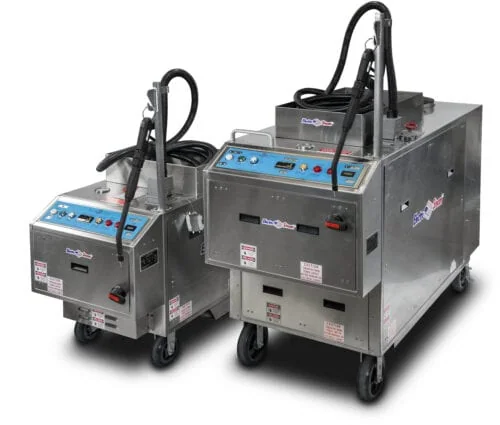
Electro-Steam is the only authorized manufacturer that offers true after-heated (superheated) steam systems, delivered via our on-board ASME-approved and stamped superheater unit. Our TruBlu portable dry steam cleaners offer a chemical-free, powerful solution that can significantly reduce time spent on cleaning tasks, effectively lowering labor costs. Carrying the ASME designator “S” stamp, TruBlu is ASME code compliant for use in the United States and meets Canadian standards.
Unlike conventional wet cleaning methods, which have the potential to flood flooring and create dangerous contamination risks, TruBlu’s dry vapor steam cleaning process prevents moisture-related equipment damage, reduces allergen buildup, and ensures superior sanitation.
Partner With Electro-Steam for Dry Steam Cleaners
Electro-Steam generators are made with the highest quality parts and are proudly made in the USA by licensed boiler operators, providing our valued customers with the following advantages:
Compliance. Canadian market certifications (cuL, CRN)
Dependability. Five-year warranty on chambers and one-year warranty on other parts.
Performance. 98% efficiency without requiring pre-heating of the feed water.
Quick production turnaround. Approximately two to four weeks for most units.
Reliability. Most dependable miniature electric steam generator on the market.
Our knowledgeable customer service and sales staff are ready to assist with any questions or concerns you may have. Contact us or request a free demo today and learn how Electro-Steam can meet your dry steam cleaning needs.
Posted by Electro-Steam on | Comments Off on Guarding Against MRSA
Over the past several years, the number of documented cases of Community-acquired Methicilin-resistant Staphylococcus aureus (CA-MRSA) in otherwise healthy people has been steadily on the rise. Many of these infections have occurred among the following groups:
Athletes who share equipment
Those sharing personal items, such as razors and towels
Posted by Electro-Steam on | Comments Off on Reducing your Chemical, Water, and Effluent Expenses
Written by Myles Compton, Process Consultant, Electro-Steam Generator
Chemical waste reduction has become an even more important issue for the powder coating industry in recent years. In many areas, zero discharge is now a strict requirement. In consideration of this, plant and job shop owners must seek a method to handle all chemical effluent in their facility, with the ultimate goal being the least amount of waste possible.
Pressure washers have been used for many years to remove heavy and tenacious soils from trucks, heavy machinery, and rail cars. For this removal process, pressure washers are the method of choice because high pressure and a large volume of water will rapidly remove these soils.
Pressure washers are also frequently used to clean and iron phosphate metal prior to powder coating. When using this method, (more…)

 Proudly Manufactured in the USA
 If you manage a commercial bakery, a snack food plant, or a facility that processes powdered ingredients, you live by a different set of rules than the rest of the food industry.