
 Proudly Manufactured in the USA
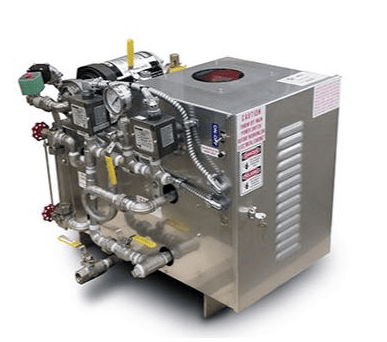
Clean Steam Generator
In the food and beverage industry, sanitation isn’t just about “looking clean”—it’s about microbial kill rates and regulatory compliance. While chemical sanitizers like quats or chlorine have been the industry standard for decades, they carry risks of corrosion, residue, and human error.
Electric steam generators offer a sophisticated alternative that replaces the “chemistry” of cleaning with the “physics” of heat.
The Science of the “Kill”: Heat vs. Chemicals
Chemical sanitizers rely on contact time and concentration. If a solution is under concentrated, it’s ineffective; if over concentrated, it’s a safety hazard.
Steam simplifies the equation:
 Total Surface Penetration: Unlike liquid chemicals that can “bead up” on hydrophobic surfaces or fail to reach micro-cracks, steam is a gas. It expands into every microscopic crevice, porous surface, and bolt thread to denature proteins and destroy pathogens like Listeria, E. coli, and Salmonella.
Biofilm Breakdown: Bacteria often protect themselves with biofilms—slimy layers that act as a shield against chemical agents. The high thermal energy of dry steam melts these biofilms on contact, exposing and neutralizing the bacteria underneath.
Protecting the Flavor Profile
In beverage production—specifically brewing, wine-making, and dairy—the slightest chemical odor can ruin a batch.
No “Off-Flavors”: Steam leaves behind zero sensory footprint. There is no vinegar or chlorine scent that could seep into a delicate vintage or a craft IPA.
Rapid Turnaround: Because there is no need to perform a “final rinse” to remove chemical suds or residue, equipment can return to production immediately after cooling. This minimizes downtime between batches.
Precision Cleaning for “Hidden” Allergen Traps
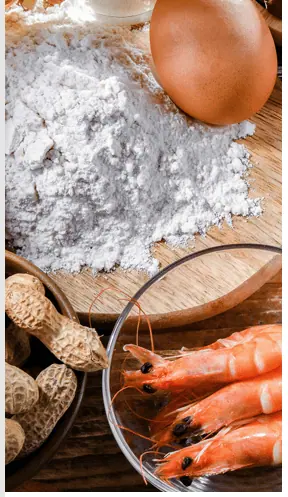
Allergens
Allergen recalls often stem from “harborage points”—tiny areas where food particles accumulate over time.
Nooks and Crannies: Conveyor hinges, slicer blades, and packaging seals are magnets for allergen dust. Steam acts as a gaseous scrubber, pressurized to reach into spaces where a brush or a chemical spray simply cannot penetrate.
Dry Steam for Dry Environments: In facilities like bakeries or snack plants, “wet” cleaning with hoses can create mold issues. Dry steam allows for the removal of flour or nut dust from sensitive machinery without introducing excessive moisture into the production environment.
Targeted Sanitation for Complex Machinery
Modern food processing uses intricate machinery—conveyor belts, fillers, and sensors—that don’t always react well to being doused in corrosive liquids.
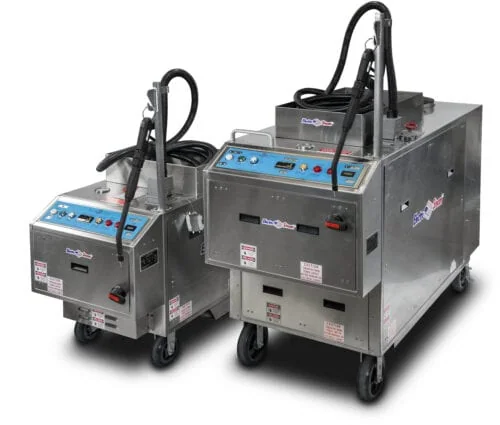
Steam Sanitation System
Dry Steam Technology: Electro-Steam units can produce “dry” steam (containing only 5% to 6% moisture). This allows you to sanitize sensitive areas, such as control panels and electronic sensors, without the risk of short-circuiting or the heavy water usage associated with traditional “wash-down” methods.
Water Conservation: At atmospheric pressure one gallon of water can produce nearly 1,700 gallons of steam. This massive expansion means you are using a fraction of the water compared to high-pressure hosing, significantly lowering your facility’s environmental footprint.
Meeting FSMA and HACCP Standards
For a QA Officer or Sanitation Manager, documentation is everything. Incorporating steam into your Hazard Analysis and Critical Control Point (HACCP) plan provides a consistent, measurable variable: Temperature.
Safety Insight: While chemical efficacy can vary based on water pH or technician error, temperature is absolute. By monitoring the output of an Electro-Steam generator, you can prove to inspectors that every surface reached the necessary thermal threshold for total sanitation.
Since 1952, Electro-Steam has been a leading manufacturer of Steam Equipment for a wide range of commercial and industrial applications. Contact us today to learn which is the best steam generator for your application.